The book of the genealogy of Jesus Christ, the son of David, the son of Abraham. Matthew 1:1
And this gospel of the kingdom shall be preached in all the world for a witness unto all nations; and then shall the end come. Matthew 24:14
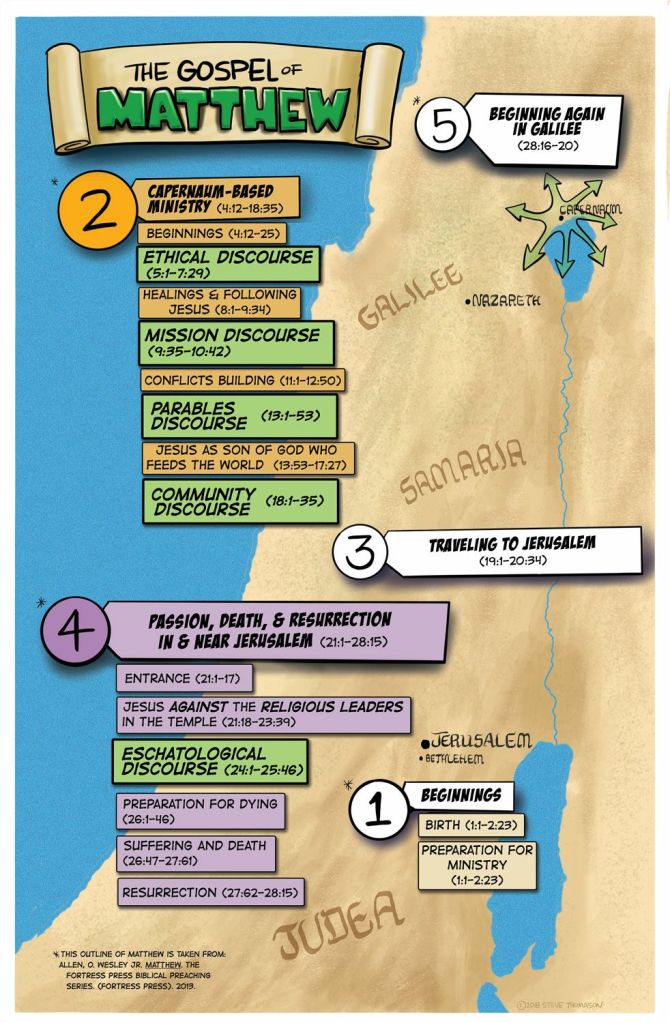
Excerpt from GQ summary of Matthew
Brief Summary: The Gospel of Matthew discusses the lineage, birth, and early life of Christ in the first two chapters. From there, the book discusses the ministry of Jesus. The descriptions of Christ’s teachings are arranged around “discourses” such as the Sermon on the Mount in chapters 5 through 7. Chapter 10 involves the mission and purpose of the disciples; chapter 13 is a collection of parables; chapter 18 discusses the church; chapter 23 begins a discourse about hypocrisy and the future. Chapters 21 through 27 discuss the arrest, torture, and execution of Jesus. The final chapter describes the Resurrection and the Great Commission.
 Wisdom in the WORD
RMFJ Bible Saturation Journey
January 2024
Matthew – Week 4
Sunday 1/21/24
Matthew 1 – Genealogy & Beginnings
Matthew 2 –
Matthew 3 –
Matthew 4 – Capernaum Ministry
Monday 1/22/24
Matthew 5 – Sermon on the Mount
Matthew 6 –
Matthew 7 –
Matthew 8 –
Tuesday 1/23/24
Matthew 9 – Mission Discourse
Matthew 10 –
Matthew 11 –
Matthew 12 –
Wednesday 1/24/24
Matthew 13 – Parable Discourse
Matthew 14 –
Matthew 15 –
Matthew 16 –
Thursday 1/25/24
Matthew 17 –
Matthew 18 – Community Discourse
Matthew 19 – Jerusalem Journey
Matthew 20 –
Friday 1/26/24
Matthew 21 – Entering Jerusalem
Matthew 22 –
Matthew 23 –
Matthew 24 – Eschatology Discourse
Saturday 1/27/24
Matthew 25 –
Matthew 26 – Passion & Crucifixion
Matthew 27 – Resurrection
Matthew 28 – Great Commission
LikeLike
The 2 Genealogies of JESUS
MATTHEW
• Descendant of Abraham
• True natural Jew
• The Man of Faith
• Through Solomon (B)
• The Heavenly Man
• The Son of David
• The Messiah
• The King of kings
• Line of Judah & David
• 14 gen Abraham – David – Babylon – Messiah
LUKE
• Descendant of Adam
• Real natural man
• The Man Jesus Messiah
• Through Nathan (*)
• The earthly man
• The Son of Man
• The Ancient of Days
• The High Priest
• Line of Judah & David
• In the order of Melchizedek [Heb5]
LikeLike
First Century Currency
⅛•⅒¢ – lepton – mite – like fish scale (Lk 12:59)
⅒¢ – assarius – farthing (Mat 10:29)
¼¢ – kodrantes – quadrans – farthing (Mat 5:26)
1¢ – denarius – 1 day’s wage (Mat 20:2)
25¢ – drachma – old coin (Mat 15:8)
50¢ – didrachma – yearly temple tax (Mt 17:24)
$1 – stater – 1 shekel (Mat 17:27)
In the first century a shekel was equated with the Greek tetradrachm (equal to four drachms), which was a silver coin of the weight of nearly 14 grams. Half a shekel therefore would be in the value of nearly 7 grams of silver, and could be equated with the Greek didrachm (equal to two drachms).
Seven different types or denominations of coins are mentioned by name: denarius, drachma, didrachm, stater, assarion, kodrantes, and lepton. In addition, there are general references to money or sums of money, for example to argurion and talenton.
LikeLike
Matthew 13 – Wheat & Tares
24 January 24 – Week 4 , Day 4
Tares look like wheat. They grow. They grow in the same place. They grow together. They look the same, blow in the wind the same. For amber waves of grain. But tares are not wheat. While the tares and wheat are still growing, before the fullness of time, before the grain grows on the stalk of wheat, the tares look the same. But tares do not produce grain; they do not produce wheat grain and cannot result in the bread of life, the fruit of the grain. When the time comes for harvest, the tares will be plainly seen as having no grain to show. Even though the tares were living alongside the wheat, the tares produced no fruit, no grain, because they were tares and no wheat. This is what clearly distinguishes the wheat from the tares. The wheat does what wheat does. It produces wheat grain. The tares however does what tares do. Takes up space alongside the wheat, taking up nourishment from the same good soil, soaking up the same rain and the same sunshine, living alongside. And at the end of times, when the harvesters come out to the field, the tares are obvious because they have no fruit, no wheat grain to show for all their living. So they are separated from the wheat grain which have borne wheat grain. And the tares are thrown into the fire as waste.
LikeLike