25 When Peter entered the house, Jesus preempted him. “What do you think, Simon?” He asked. “From whom do the kings of the earth collect customs and taxes: from their own sons, or from others?”
26 “From others,” Peter answered.
“Then the sons are exempt,” Jesus declared. 27 “But so that we may not offend them, go to the sea, cast a hook, and take the first fish you catch. When you open its mouth, you will find a stater coin. Take it and give it to them for my tax and yours.”
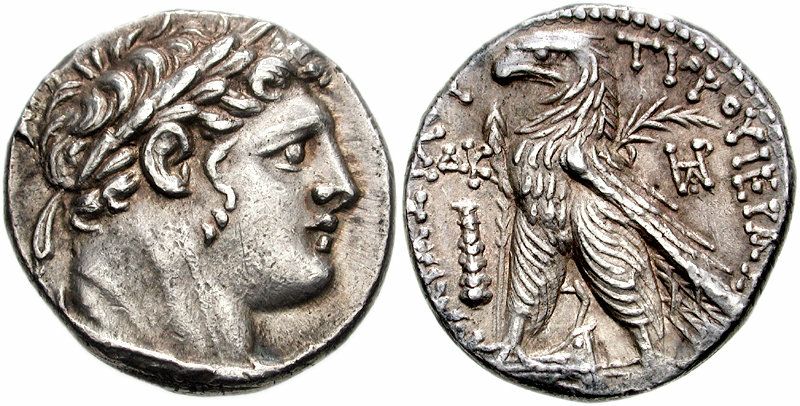
This is surprising. In 40+ years — and especially in the past 10 years in which we have all had easy access to the interlinear and all sorts of study resources — we have apparently never thought of and never come across a simple closer look at the NT currency terms. And it is not too complicated at all.
So, here is little key which if everyone had it would be a fairly simple way for a more accurate reading instead of these terms which no reader every really understands including mite, farthing, denarius, talent etc.
Thanks to our first century publican who recorded the greatest number of usages of these terms, this was fairly easy to compile and adds useful sense to our reading of Matthew this week.
…
First Century Currency
¹⁄₆₄¢ – lepton – mite – as a fish scale (Lk 12:59)
⅒¢ – assarius – farthing (Mat 10:29)
¼¢ – kodrantes – quadrans – farthing (Mat 5:26)
1¢ – denarius – 1 day’s wage (Mat 20:2)
25¢ – drachma – 1 month’s wage (Mat 15:8)
50¢ – didrachma – yearly temple tax (Mt 17:24)
$1 – stater – tetradrachm – 1 shekel (Mat 17:27)
In the first century a shekel was equated with the Greek tetradrachm (equal to four drachms), which was a silver coin of the weight of nearly 14 grams. Half a shekel therefore would be in the value of nearly 7 grams of silver, and could be equated with the Greek didrachm (equal to two drachms).
Seven different types or denominations of coins are mentioned by name: denarius, drachma, didrachm, stater, assarion, kodrantes, and lepton. In addition, there are general references to money or sums of money, for example to argurion and talenton.
 Wisdom in the WORD
https://byustudies.byu.edu/article/coins-in-the-new-testament/
LikeLike